
Proportion before decoration
If the dimensions of a room are wrong, no material will rescue it. We resolve the volume first, and only then consider what covers it.

About
Nesva began in 2021 with a single lease, a borrowed drawing board and a two-bedroom flat in Bloomsbury. Eighteen years later the method has not changed, only the scale.
Sanjana Tyagi left a conservation practice in Delhi because she had grown tired of being asked to make old buildings look new. The studio she started instead was founded on a small number of refusals: no work she could not personally attend, no material pretending to be another, no room finished before its proportions were right.
Those refusals have cost us commissions and we have kept them anyway. They are the reason the practice remains at twenty-two people rather than a hundred, and the reason a principal is still present on every project we take.
“A building tells you what it wants to be. Most of the work is learning to stop talking over it.”
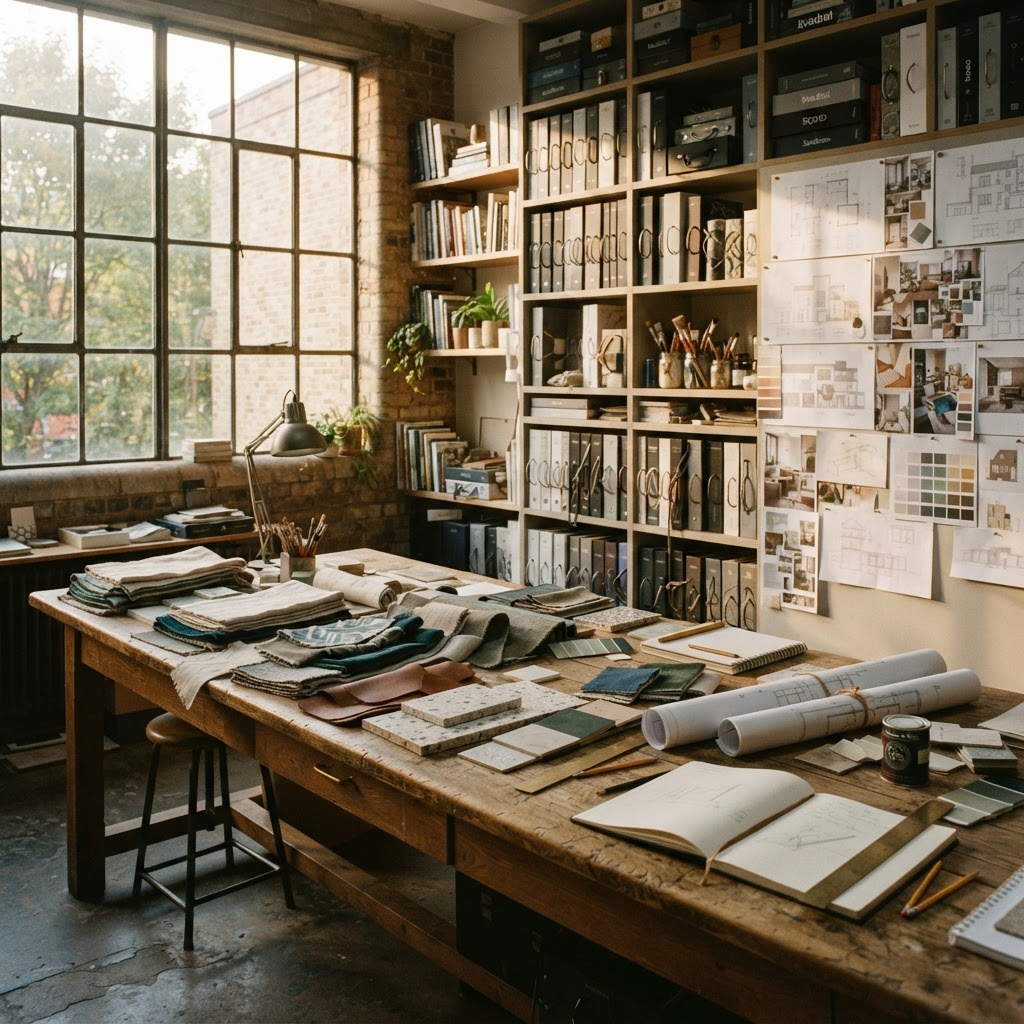
If the dimensions of a room are wrong, no material will rescue it. We resolve the volume first, and only then consider what covers it.
Stone should be heavy, timber should move, brass should darken. We specify materials that age rather than degrade, and we never disguise one as another.
Everything we commission is made by a person we can name. Where a machine produces a better result we use one, but the decision is always deliberate.
A house in Udaipur and a house in Jaipur should not be the same house in different colours. Place, climate and history set the terms.
Luxury is a question of quality per square metre, not quantity. We would rather deliver four extraordinary rooms than eleven adequate ones.
Daylight is surveyed before a plan is drawn and artificial light is designed before a fabric is chosen. It is the first material, not the last.
Sanjana Tyagi leaves a conservation practice in Delhi and takes a lease on one room above a bookbinder on Hauz Khas Village. The first commission is a two-bedroom flat in South Delhi.
A Grade II listed rectory in Rajasthan. The project runs eleven months over and teaches the studio everything it now knows about conservation programme.
Prashant Tyagi starts collecting samples in a single drawer. It now occupies an entire wall and holds over four thousand references.
A twenty-two room boutique hotel in Bengaluru. The studio learns to design for a ten-year maintenance cycle rather than a photograph.
A second studio near Saket, established primarily to be closer to the workshops of the Rajasthan and the quarries of Rajasthan.
After two years and eleven prototypes, the studio releases its first furniture collection, produced by a workshop of four in the Rajasthan.
A thirty-four month conservation on the Lake Pichola. The studio’s most complex commission and the one that defines its position on restoration.
Eighty-six completed residences across twelve Indian cities, with satellite offices in India, and a network of ninety-one named artisans.
Begin
The commissions we remember are rarely the straightforward ones. If yours has a problem nobody has solved yet, that is usually a good sign.
All enquiries are handled in confidence. A significant portion of our work is never published; where discretion is required, we operate under private terms and no imagery leaves the studio.